
What Voltage Range Is Considered Medium Voltage?
Navigating the complexities of electrical power distribution requires a precise understanding of voltage classifications. Whether you are an electrical engineer designing a new industrial facility or a procurement officer sourcing cables and switchgear, knowing exactly what voltage range is considered medium voltage is the foundation of safe and compliant system design.
However, looking for a single, universal number can be frustrating. The exact medium voltage definition shifts slightly depending on where you are in the world and which regulatory body you are consulting.
In this guide, we will break down the medium voltage range according to major global standards, compare it against low and high voltage systems, and explore the specialized equipment required to manage it safely.

Key Takeaways
The Short Answer: Broadly speaking, the medium voltage range spans from 1,000 volts (1 kV) to 69,000 volts (69 kV).
ANSI/IEEE (North America): Typically defines medium voltage as greater than 1 kV up to 69 kV.
IEC (International): Generally considers alternating current (AC) medium voltage to be between 1 kV and 52 kV (and sometimes up to 100 kV depending on the specific standard).
Core Application: Medium voltage is primarily used for electrical power distribution—bridging the gap between high-voltage transmission lines and low-voltage end-user equipment.
Equipment: Handling these voltage levels requires specialized medium voltage equipment, including heavy-duty transformers, arc-resistant switchgear, and heavily insulated medium voltage cables.
What is Considered Medium Voltage? The Short Answer
If you need a fast, standard-agnostic answer: Any alternating current (AC) system operating above 1,000 V (1 kV) and below 69,000 V (69 kV) is generally considered medium voltage.
Systems below 1 kV are low voltage (the power in your home or standard factory floor machines), while systems above 69 kV are high voltage (the massive transmission towers cross-country).
To understand the nuances, however, we must look at the specific engineering standards that govern electrical infrastructure.

Defining the Medium Voltage Range: ANSI vs. IEC Standards
The exact boundaries of the medium voltage range depend heavily on the regulatory framework governing your region or project. The search for "medium voltage range ansi vs iec" is incredibly common among engineers working on international projects because the discrepancies, while minor, have major implications for equipment specification.
The ANSI/IEEE Definition (North America)
In the United States and North America, the American National Standards Institute (ANSI) and the Institute of Electrical and Electronics Engineers (IEEE) set the benchmark.
According to IEEE Standard 141 (Red Book) and ANSI C84.1, the medium voltage classification applies to systems greater than 1,000 Volts and less than 69,000 Volts.
Practically speaking, the National Electrical Code (NEC) often applies specific medium voltage cable and wiring rules (such as Article 328) to systems operating between 2,001 V and 35,000 V.
The IEC Definition (International)
For the rest of the world, the International Electrotechnical Commission (IEC) dictates electrical standards.
The IEC typically defines the low voltage limit as up to 1,000 V AC.
The IEC medium voltage range starts at 1 kV AC and generally extends up to 52 kV AC.
It is worth noting that some older or highly specific IEC documentation may group voltages up to 100 kV into a broader distribution category, but 52 kV is the standard modern ceiling for MV equipment classifications.
The Difference Between Low, Medium, and High Voltage
Understanding the difference between low, medium, and high voltage is crucial for safety, infrastructure planning, and selecting the correct insulation and clearance requirements.
Classification | Voltage Range (Approximate) | Primary Function | Typical End-Users |
Low Voltage (LV) | Up to 1,000 V (1 kV) | End-use consumption. | Residential homes, commercial lighting, standard factory motors (e.g., 120V, 480V, 600V). |
Medium Voltage (MV) | 1 kV to 69 kV | Regional and local power distribution. | Utility companies, heavy industrial plants, large commercial campuses, renewable energy farms. |
High Voltage (HV) | 69 kV to 230 kV+ | Long-distance power transmission. | National power grid operators connecting power plants to regional substations. |
Medium Voltage vs. Low Voltage
The leap from low to medium voltage changes everything about system design. In low voltage systems (under 1 kV), standard PVC insulation and basic circuit breakers are sufficient. When you cross into medium voltage vs low voltage, the risk of arc flash and electrical tracking increases exponentially. Air alone is no longer a sufficient insulator at close distances, requiring robust, specialized switchgear and thick, extruded cable insulation.
Medium Voltage vs. High Voltage
Conversely, the debate of medium voltage vs high voltage usually centers on transmission versus distribution. High voltage is strictly for moving immense amounts of power over hundreds of miles to minimize line losses. Medium voltage is what high voltage is stepped down to when it arrives at a city or a massive industrial plant—it is high enough to distribute power efficiently across a facility, but low enough to be managed by localized substations.
Standard Medium Voltage Levels in Industry
While the range spans from 1 kV to 69 kV, engineers do not pick random numbers within that bracket. Electrical systems are designed around standard medium voltage levels to ensure compatibility across transformers, cables, and grid infrastructure.
North American Voltage Classes
If you are operating under ANSI/IEEE standards, you will encounter these common nominal system voltages:
4.16 kV and 4.8 kV: Common in heavy manufacturing for powering large motors and chillers.
12.47 kV, 13.2 kV, and 13.8 kV: The most prevalent distribution voltages. 13.8 kV is the industry workhorse for large industrial plants, hospitals, and university campuses.
24.94 kV and 34.5 kV: Used heavily by utility companies for primary distribution circuits running through cities and rural areas, as well as in wind and solar farm collector systems.
International Voltage Classes
Under IEC standards, the steps look slightly different:
3.3 kV and 6.6 kV: Common for large industrial motors and mining equipment.
11 kV and 22 kV: The standard utility distribution voltages in Europe, Asia, and parts of the Middle East.
33 kV: Widely used for sub-transmission and renewable energy array connections.
What is Medium Voltage Used For?
If someone asks, "what is medium voltage used for?" the simplest answer is distribution. It is the vital middleman of the power world.
Electrical Power Distribution and the Power Grid
Utility companies rely on MV electrical systems to carry power from main substations to individual neighborhoods. When you see wooden utility poles with three wires running across the top, those are typically carrying medium voltage (e.g., 13.8 kV or 34.5 kV). Before entering a home, a pole-mounted transformer steps this down to low voltage (120/240V).
Industrial Plants and Heavy Manufacturing
Large-scale facilities cannot operate entirely on low voltage; the sheer amount of current (Amperage) required would necessitate cables the size of tree trunks. By bringing medium voltage directly into the plant and distributing it to local load centers, industrial plants reduce energy losses and save millions on copper and aluminum wiring.
Renewable Energy Facilities
Wind turbines and solar inverter stations typically generate power at low or low-medium voltages. This power is immediately stepped up to standard medium voltage levels (often 34.5 kV or 33 kV) to run through underground collection networks before hitting a main substation to join the high-voltage grid.

Key Medium Voltage Equipment in MV Electrical Systems
Because of the extreme energy potential, medium voltage equipment is drastically different from its low-voltage counterparts. You cannot simply scale up low-voltage gear; the physics of medium voltage require unique engineering.
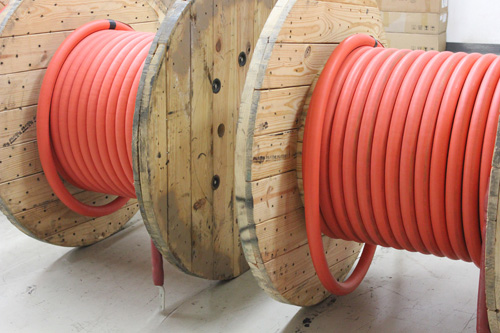
Medium Voltage Cables
Perhaps the most critical component of distribution, medium voltage cables are highly engineered. Unlike a simple 600V wire, an MV cable features multiple layers: a conductor, a conductor shield, thick primary insulation (commonly EPR or XLPE), an insulation shield, a metallic shield (like copper tape or wire) to manage the electrical field and carry fault currents, and an outer jacket. [Note: Always consult your manufacturer—such as the experts at FR-Cable—to select the correct insulation thickness (100%, 133%) for your system's grounding setup.]
Medium Voltage Switchgear and Circuit Breakers
Medium voltage switchgear voltage ratings must account for both continuous current and massive fault currents. This equipment utilizes advanced arc-quenching technologies. While older systems used oil or air blasts, modern MV circuit breakers predominantly use vacuum bottles or SF6 gas to extinguish arcs safely.
Transformers and Substations
Transformers are the gateways of the MV system. Step-down transformers take the 13.8 kV or 34.5 kV power and reduce it to the 480V or 600V needed to run factory machinery. These are often housed in unit substations, paired directly with secondary switchboards.
Navigating Standards: NEC, IEEE, and NEMA
When specifying systems, you must ensure all components align with the governing bodies:
IEEE (Institute of Electrical and Electronics Engineers): Defines the system design calculations, grounding requirements, and protection schemes.
ANSI/NEMA: Dictates the physical manufacturing standards for equipment like switchgear, enclosures, and transformers in North America.
NEC (National Electrical Code): Governs the installation practices. For instance, NEC Article 328 covers Medium Voltage Cable (Type MV), detailing how it must be routed in conduit, cable trays, or direct burial.
IEC (International Electrotechnical Commission): Provides the equivalent global manufacturing and testing standards for international projects.
Conclusion
Understanding the medium voltage range—generally defined as 1 kV to 69 kV (ANSI) or up to 52 kV (IEC)—is the first step in successful electrical infrastructure planning. The distinction between low, medium, and high voltage dictates everything from the physical size of your substations to the specific layers of insulation extruded onto your cables.
By adhering to standard medium voltage levels and specifying purpose-built, high-quality medium voltage equipment, engineers can ensure that their power distribution networks are safe, efficient, and compliant with global standards.
Frequently Asked Questions (FAQ)
1. How many volts is medium voltage exactly?
While standards vary slightly, medium voltage is universally accepted as any AC voltage greater than 1,000 volts (1 kV) and less than 69,000 volts (69 kV) in North America, or up to 52 kV internationally.
2. Is 480V considered medium voltage?
No. 480V (or 0.48 kV) falls well under the 1,000V threshold, making it a Low Voltage (LV) classification. It is a very common industrial low voltage.
3. What happens if you use low voltage cable for a medium voltage application?
This will result in an immediate and catastrophic failure. Low voltage insulation cannot withstand the electrical stress of medium voltage, leading to rapid insulation breakdown, arcing, fires, and lethal hazards.
4. Why do industrial plants use medium voltage instead of low voltage?
Using medium voltage allows facilities to transmit large amounts of power over long distances with smaller, lighter cables. Higher voltage means lower current (Amperage) for the same amount of power, which drastically reduces power losses (voltage drop) and copper costs.
5. How do you test medium voltage cables?
Medium voltage cables are typically tested using Very Low Frequency (VLF) AC withstand testing or Partial Discharge (PD) testing to assess the integrity of the insulation without causing damage to the cable structure.


Comments