
What is the difference between XT60 and MC4 PV Connectors?
Short Answer: Which connector is better for solar PV?
For solar photovoltaic (PV) use, MC4 PV connectors are generally the better match because they’re designed around outdoor conditions—locking to reduce accidental disconnects, weatherproof sealing, UV-resistant materials, and termination methods intended for PV wiring.
XT60 can work in some DIY/off-grid battery contexts, but it’s typically not the same “outdoor PV connector” standard. If your goal is a clean, robust PV installation that survives sun, moisture, vibration, and long cable runs, MC4 is usually the safer technical default.
Featured snippet-ready definition & verdict
XT60 vs MC4: XT60 is a DC connector type often used in battery/RC systems, while MC4 is a PV connector type designed for solar panel wiring with outdoor sealing and a locking mechanism.
Verdict for PV: Choose MC4 for solar panel strings and PV harnesses unless you have a specific, validated reason to use XT60 and an adapter + protection strategy.
What each connector is “for” (not just how it looks)

XT60 connectors in the battery/RC ecosystem
XT60 connector is widely used in projects where people want a compact, straightforward DC connection—commonly in battery packs, hobby robotics, portable power setups, and related “power leads.” In these use cases, the environment is often less punishing than long-term roof-mounted or ground-mounted solar exposure.
So even though XT60 is electrical (DC), the ecosystem emphasis tends to be:
practical mating/unmating
manageable current for the intended battery application
easy assembly for DIY projects
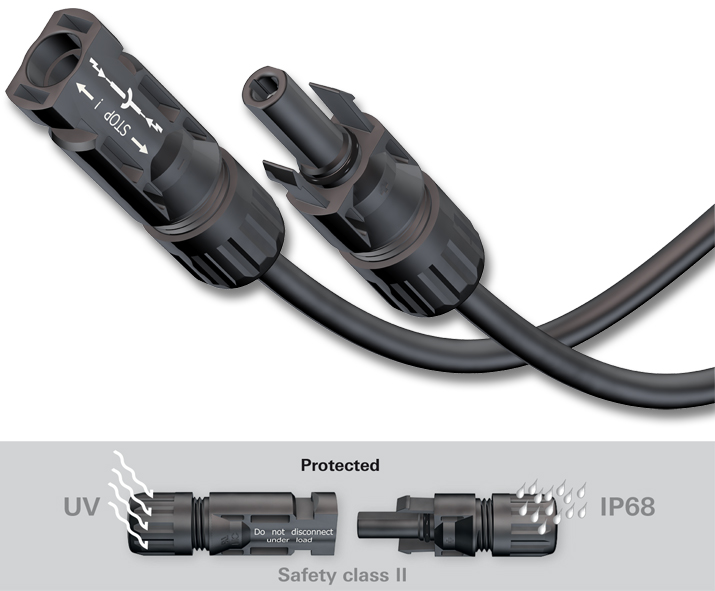
MC4 connectors in the PV ecosystem
MC4 connector is a common term for solar PV connector types designed for connecting solar panel wiring to a PV combiner, inverter input, or wiring harness in a series connection (PV string) or other PV topology.
The ecosystem emphasis is different:
reliable connection in outdoor conditions
locking mechanism (MC4 latch) to reduce accidental separation
weatherproofing and durability for exposure (sun/UV, moisture, temperature cycling)
termination and cable compatibility for PV harness builds
In short: they may both “plug into DC,” but they’re engineered for different failure modes.
XT60 vs MC4: side-by-side comparison (what matters outdoors)
Below is a practical comparison focusing on what typically determines real-world PV reliability.
Locking mechanism and vibration resistance
MC4: Designed with a locking mechanism (MC4 latch) intended to resist unintended disconnects from vibration, handling during installation, and outdoor movement.
XT60: Uses its own locking approach (varies by manufacturer), but it’s generally not marketed with PV-harness outdoor reliability as the primary design goal.
Why you should care: In PV, the cost of a loose/partial connection can be high—because contact resistance can increase heat over time. The best
connector is the one engineered to stay fully mated.
Weatherproofing, UV resistance, and insulation materials
MC4: Typically marketed/engineered as weatherproof PV connectors suitable for outdoor PV runs. Many MC4-type systems use materials and sealing methods intended to handle UV exposure and moisture.
XT60: Commonly used in environments where robust outdoor sealing/UV resistance may not be the same priority. This doesn’t automatically mean XT60 will fail outdoors—but it means you need to verify IP rating (Ingress Protection) and UV resistance claims for the exact XT60 model you’re buying.
Source note: Always confirm with the manufacturer’s datasheet for your exact connector batch/model (UV resistance, sealing method, and operating temperature range). [source needed]
Connector housing and “how the seal is achieved”
Think of sealing as a system, not a single feature:
MC4: The connector design and termination method are meant to work together to keep the interface protected.
XT60: The connector may seal differently (or not as thoroughly) at the housing/cable interface, depending on the specific product variant.
Practical takeaway: If you plan outdoor PV use, it’s not enough that “it’s waterproof”—you need the connector + cable termination to be compatible with that outdoor requirement.
Current/voltage ratings—why the exact numbers depend on the model
Your keyword list includes XT60 current rating / MC4 current rating and XT60 voltage rating / MC4 voltage rating. Here’s the important editorial point:
The real ratings depend on:
the manufacturer and connector series
the exact contact design
the termination method
the wire gauge and insulation type
ambient temperature and installation conditions
Because of that, the most accurate guidance is:
Compare datasheet ratings for your specific XT60 model vs your specific MC4 family.
Ensure your system DC voltage range and expected current are within both the connector and cable constraints.
Don’t assume “they’re both DC, so the rating is the same.”

Termination compatibility (crimp style + cable gauge)
This is a major differentiator that many quick blog posts skip.
MC4: Typically designed for PV cable harness builds using crimping connectors (MC4 crimp) methods and specific cable size ranges. The termination affects contact reliability and sealing.
XT60: Uses its own termination ecosystem, often associated with battery cable building methods and different cable size expectations.
Key risk when mixing: If you use an XT60 termination style on a PV cable—or an adapter that doesn’t support your PV cable size properly—you can end up with:
poor contact geometry
reduced contact area
sealing that doesn’t match outdoor needs
increased contact resistance
Can you use XT60 instead of MC4 for solar?
When XT60 can be acceptable (with limitations)
XT60 may be workable in some non-standard PV wiring contexts, such as:
prototype setups where you fully control environment and replace parts as needed
portable or temporary solar where connectors are not permanently exposed
indirect connections (e.g., using PV to charge a battery via an intermediate controller where the connector exposure is limited)
Even then, you should treat XT60 as an engineering choice you validate, not a guaranteed PV connector replacement.
When you should avoid XT60 for PV strings
Avoid XT60 for typical roof/ground PV string harnesses when:
connectors are exposed to sun/UV and moisture for long periods
you need the locking mechanism reliability for outdoor vibration and accidental tug resistance
you need PV-grade weatherproof sealing and consistent termination across your wiring harness
you’re doing a system intended to run unattended for years
Because MC4-type connectors are built for this environment, they usually reduce uncertainty.
Can you connect XT60 to MC4?
The truth about “connector compatibility”
In general, XT60 vs MC4 PV Connectors are not directly compatible due to:
different connector form factors and mating geometry
different internal contact designs
different termination styles expected for the cable system
So “Can I connect XT60 to MC4?” usually means: can I use an adapter.
When an adapter is the right move
An XT60 to MC4 adapter can help when:
you need a specific transition between an XT60-based component (often battery-side) and an MC4-based PV harness (panel-side)
you can verify that the adapter is rated for the DC voltage/current you will operate at
you can ensure proper cable termination and outdoor protection
Important: Adapters solve mating; they don’t automatically solve sealing, ratings, or termination quality. Those are still your responsibility.
How to connect XT60 to MC4 (safe step-by-step)
Step 1: Confirm polarity and system voltage range
Identify which contact is positive vs negative for both sides.
Verify your PV/V-source voltage range and your downstream device voltage tolerance.
Never “test by sparking.” Use continuity checks and visual polarity labeling.
Step 2: Match connector ratings and wire sizes
Check XT60 connector current rating and MC4 current rating for your specific product models.
Ensure the expected operating current is within the lowest-rated component in the chain (connector, adapter, cable, termination).
Match wire gauge / cross-sectional area to both connector sides. This directly affects contact reliability and temperature rise.
Step 3: Use correct termination (crimp tool / method)
For MC4, use the correct MC4 crimping method (and appropriate crimp tool for the terminal and cable size).
For XT60, use the correct XT60 terminal style and crimp/assembly method for the connector you’re using.
Poor termination is a leading cause of connector heating and premature failure.
Step 4: Add strain relief and proper outdoor protection
If any portion is exposed:
Provide strain relief so the connector isn’t taking mechanical load.
Consider an enclosure or protective boot that preserves weatherproofing.
Ensure mating remains fully latched (especially the MC4 latch side).
Use proper sealing practices consistent with the adapter’s intended installation.
Step 5: Test before going into service
Before you run PV:
Verify continuity (correct polarity).
Check that both connector sides fully latch.
Inspect terminations for mechanical security.
If possible, perform a low-risk functional test with the system protected by appropriate safeguards (e.g., fusing/overcurrent protection as applicable).
Buying checklist: choosing the right PV connector type
Quick checklist for home solar installers
Use this as your decision filter when comparing PV connector types:
Outdoor suitability: Is it outdoor rated and UV-resistant for long-term exposure? (Confirm in the datasheet.)
Weatherproofing: Does the connector + cable termination create a sealed interface appropriate for moisture and temperature cycling?
Locking reliability: Does it have a locking mechanism (MC4 latch) or equivalent that resists accidental disconnects under vibration?
Termination compatibility: Are you using the correct crimp/termination method and matching wire size for that exact connector?
Electrical ratings (real specs): Does the connector family’s current carrying capacity and DC voltage rating cover your operating conditions?
System design fit: Are you building a PV string with the connector placed where it will see real outdoor stress and repeated environmental cycling?
Common mistakes to avoid
Assuming interchangeability because both are DC connectors.
Ignoring termination quality (crimp tool and wire gauge mismatch).
Choosing an adapter without outdoor protection strategy.
Using the “max rating” number without checking cable limits and contact conditions.
FAQ
1) What is the main difference between XT60 and MC4?
XT60 is commonly used in battery/RC-style DC systems, while MC4 is designed for PV solar panel wiring—especially for outdoor durability, locking behavior, sealing, and compatible PV cable termination.
2) Are XT60 connectors safe for solar panels?
They may be safe only in specific, controlled contexts. For typical long-term outdoor PV string use, MC4-type connectors are generally the safer choice because they’re designed for weatherproof and UV exposure. Always verify ratings and outdoor protection requirements for your exact XT60 model. [source needed]
3) Can I use XT60 instead of MC4 for solar?
You can, but it’s usually not the default recommendation for permanent PV installs. If you do, validate: outdoor sealing/UV, locking behavior, wire gauge compatibility, and termination method quality. Often, an MC4-based PV harness reduces uncertainty.
4) Can I connect XT60 to MC4 directly?
Usually no. XT60 and MC4 are not designed to mate directly, so you typically need an XT60 to MC4 adapter (and then verify ratings, polarity, wire sizes, and outdoor protection).
5) What wire gauge fits XT60 vs MC4?
The correct wire gauge depends on the connector model and the manufacturer’s specified cable range for termination. Check the datasheets for the exact XT60 and MC4 variants you’re using.
6) Do MC4 connectors have a locking mechanism?
Yes—MC4-type connectors are known for a locking latch that helps prevent accidental separation. You should ensure the latch fully engages during installation.
Conclusion: Make the call based on PV requirements, not convenience
If you’re building a PV system meant to live outside—sun, moisture, temperature cycling, vibration—MC4-type PV connectors are engineered for that job. XT60 can be useful in battery and portable contexts, but it typically isn’t the same “outdoor PV connector” choice unless you’ve validated the full electrical + mechanical + environmental requirements.
If you’re sourcing connectors or adapters for a home solar or off-grid build, the best next step is simple: match the connector family to your cable system, confirm ratings from the manufacturer datasheets, and use the correct termination method. That’s what turns “it fits” into “it lasts.”


Comments