
What Is Aluminum PV Wire? Benefits, Ratings, and Best Applications Explained
- Xie
- Mar 16
- 9 min read
Aluminum PV wire is a single-conductor photovoltaic cable designed for solar power applications that uses an aluminum-alloy conductor instead of copper.
In the U.S. market, it is commonly sold as Type PV cable listed to UL 4703, often with cross-linked polyethylene (XLPE) insulation, sunlight resistance, wet and dry location ratings, and voltage ratings up to 2000V depending on the product. Southwire and Wire America both publish aluminum PV wire products with these characteristics, including UL 4703 references, 90°C wet/dry ratings, direct-burial suitability, and solar-use language tied to NEC Article 690.
That is the definition. The more useful answer is this: aluminum PV wire is typically chosen when lower conductor weight and lower material cost matter enough to justify larger conductor sizes and more careful attention to aluminum-compatible terminations.
Key Takeaways
Aluminum PV wire is a single-conductor solar cable used in photovoltaic power systems and available as Type PV products listed to UL 4703.
U.S. market examples show aluminum PV wire commonly built with stranded AA-8000/AA-8176 aluminum alloy conductors and XLPE insulation.
Published product examples show common ratings such as 2000V, 90°C wet/dry, sunlight resistance, direct burial, and use in PV source and output circuits.
Aluminum PV wire’s main advantages are usually lower weight and potentially better material economics on larger runs, while its tradeoffs include larger conductor size and more attention to terminations.
NEC-related guidance cited by manufacturers says single-conductor PV wire of all sizes may be used in outdoor cable trays for PV source and output circuits under the relevant rule set.
The best applications are typically larger commercial, ground-mount, and utility-style projects where conductor scale and cable weight matter more than compact routing. This last point is an engineering judgment based on the cited product characteristics and aluminum-related equipment considerations.
What Is Aluminum PV Wire?
Aluminum PV wire is a single-conductor cable for solar power systems that uses aluminum rather than copper as the conductor material. Wire America’s published product description says its aluminum 2kV photovoltaic cable is “primarily used to interconnect grounded and ungrounded photovoltaic (PV) power systems,” while Southwire describes its product family as “Single Conductor Photovoltaic (Type PV) Power Cable 2000 Volt Aluminum Conductor XLPE Insulation.”
UL’s wire and cable application guide is also useful here because it explains that conductor material matters in product identification. It says that if the conductor material is aluminum or copper-clad aluminum, the product, tag, or carton markings identify that conductor material, rather than leaving it implicit.

In plain language, aluminum PV wire is not a vague marketing label. It is a clearly identified solar wire category with specific conductor material, markings, ratings, and installation implications.
How Aluminum PV Wire Is Built
Aluminum-alloy conductor
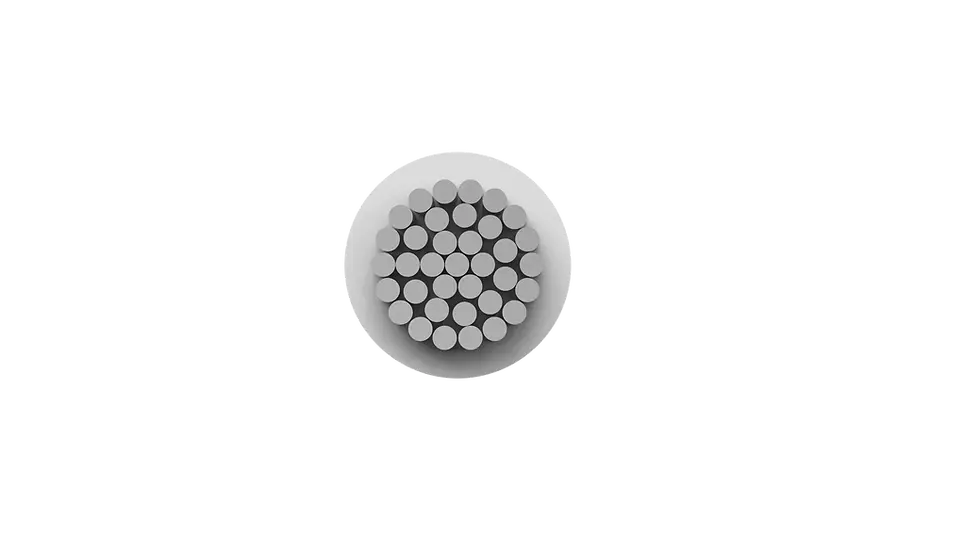
Published U.S. product examples do not describe aluminum PV wire as plain household-style aluminum. Southwire specifies AA-8176 stranded aluminum alloy conductors, while Wire America describes compact stranded 8000 Series aluminum alloy conductors.
That detail matters because modern aluminum conductor discussions in power applications are typically about aluminum alloy conductors engineered for wiring use, not older stereotypes about aluminum branch-circuit problems.
XLPE insulation
Both Southwire and Wire America list cross-linked polyethylene (XLPE) insulation for their aluminum PV wire products. Southwire describes XLPE insulation and notes heat, moisture, and sunlight resistance, while Wire America specifies shrinkback-resistant XLPE with gas/oil and sunlight resistance.
That aligns with what the solar market expects from PV wire: durability outdoors, wet/dry suitability, and insulation performance appropriate for photovoltaic environments.
Single-conductor construction
The aluminum PV wire examples surfaced here are single-conductor products. Southwire explicitly calls the family a single-conductor photovoltaic power cable, and Wire America describes it as single-conductor cable.
That matters because much of PV wire selection is tied to source circuits, output circuits, and routing methods where single-conductor cable is standard practice.
What Ratings Matter Most?
When buyers ask about aluminum PV wire ratings, they usually mean four things: voltage, temperature, environmental suitability, and listing.
Voltage rating
The examples here are rated up to 2000V. Southwire’s product family is described as 2000-volt aluminum conductor PV cable, and Wire America lists a 2000V rating on its aluminum photovoltaic cable products.
That is important for modern solar design because higher-voltage system architectures have made 2000V-rated cable increasingly relevant in large-scale applications. This general relevance statement is industry context and should be paired with additional project-level references if used in a technical specification document. [source needed]
Temperature rating
Southwire states its aluminum PV wire is rated 90°C for exposed or concealed wiring in wet or dry locations, and Wire America also lists 90°C as the temperature rating. Southwire further notes conductor operating limits of 130°C for emergency overload and 250°C for short-circuit conditions for its listed product family.
Sunlight, wet-location, and direct-burial ratings
The product examples consistently emphasize outdoor suitability. Southwire lists the product as sunlight resistant, rated for direct burial, and suitable for wet or dry locations. Wire America states similar properties, including sunlight resistance, wet/dry suitability, and direct-burial rating.
For U.S. solar buyers, those are not minor details. They are core indicators that the cable is intended for real photovoltaic field conditions rather than generic building wire use.
UL and standards references
Southwire’s published specs reference UL 4703, UL 44, and UL 854, and Wire America likewise lists UL 4703, UL 44, and UL 854 among applicable listings or standards. Southwire also references ASTM B836 and AA 8176 stranded aluminum alloy conductors.
UL’s application guide reinforces that markings and listing information should be consulted to determine ratings and installation suitability.
The Main Benefits of Aluminum PV Wire
The strongest articles on this topic do not pretend aluminum PV wire is universally better than copper. The benefits are real, but they are contextual.
1. Lower cable weight
Aluminum’s major practical advantage is lower weight compared with copper. That makes handling long runs easier and can be especially relevant when conductor sizes get large. Southwire’s published weights for large aluminum PV conductors illustrate how product weight is a real specification variable in this category.
A precise metal-density comparison would require an additional primary materials reference, so I am keeping that point practical rather than numerical.
2. Potentially better material economics
Aluminum is commonly chosen because it can reduce conductor-material cost compared with copper in the right applications. Because metal prices change constantly and no live commodity source is cited here, that point should remain general rather than numerical. [source needed]
Still, this is the economic logic behind the category. Aluminum PV wire exists because some solar projects care deeply about conductor cost at scale.
3. Strong fit for large conductor sizes
Southwire’s aluminum PV family spans 6 AWG through 1000 kcmil, which shows the category is intended for serious power-cable use rather than niche specialty wiring.
As conductor sizes increase, aluminum often becomes more commercially interesting because the savings can compound across long distances and many parallel runs. That is a project-economics inference grounded in the available size range and common purchasing logic.
4. Suitability for outdoor PV environments
The combination of XLPE insulation, sunlight resistance, wet/dry location ratings, direct-burial suitability, and UL 4703 references makes aluminum PV wire a legitimate solar-environment cable rather than an improvised substitute.
The Main Limitations and Design Considerations
A credible article has to explain the tradeoffs, not just the benefits.
1. Larger conductor size than copper for the same job
UL’s panelboard application guide states that aluminum wire is larger than copper wire of the same ampacity, which is one reason enclosures need more gutter space and wire-bending room when aluminum is used.
This is one of the most important truths about aluminum PV wire. Its economic appeal does not remove the need to account for larger conductor geometry.
2. Terminations require attention
UL’s panelboard guide says wiring terminals must be identified for use with aluminum wire, and equipment evaluated for both conductor materials will be marked accordingly. If the equipment has not been evaluated for aluminum, the marking will read “Use Copper Wire Only.”
That is a critical buying point. Aluminum PV wire is only a good choice if the rest of the connection path is ready for it.
3. Space planning matters more
Because aluminum conductors are larger for the same ampacity, UL notes that enclosures require more cross-sectional area, more wire-bending space, and potentially more attention to spacing between terminals.
For specifiers, that makes aluminum a system-design decision, not a drop-in commodity swap.
Best Applications for Aluminum PV Wire
Commercial rooftop solar
Aluminum PV wire can make sense in commercial rooftop projects when conductor runs are large enough for weight and material economics to matter, and where equipment compatibility has been planned correctly. Because rooftop layouts vary widely, this is a case-by-case design judgment rather than a blanket rule.
Ground-mount systems
Ground-mount solar is often a stronger fit because installations may involve longer runs, less constrained routing, and more repeated conductor patterns. The product characteristics cited here—outdoor cable-tray suitability, direct burial, and large conductor sizes—support that use case well.
Utility-scale solar
This is where aluminum PV wire often becomes easiest to justify. Southwire’s size range up to 1000 kcmil, 2000V rating, and outdoor solar-use language point clearly toward larger project environments.
Again, that does not mean aluminum is mandatory. It means its value proposition becomes stronger as project scale increases.
Aluminum PV Wire vs Standard Copper PV Wire
This comparison is the decision point many readers are actually searching for.
Copper generally offers:
smaller conductor size for the same ampacity
easier fit in space-constrained equipment
simpler compatibility at many terminations
Aluminum generally offers:
lower cable weight
potentially lower material cost [source needed]
strong relevance in larger-scale conductor programs
UL’s panelboard guide is especially useful on the practical difference: aluminum conductors require larger spaces and aluminum-compatible terminals, while the product markings identify whether equipment is approved for copper, aluminum, or both.
That is why the best question is not “Which one is better?” It is “Which one is better for this project?”
What Buyers Should Check Before Specifying It
Before specifying aluminum PV wire, buyers should verify five things:
Listing and type designationConfirm that the product is listed for the intended photovoltaic use and that ratings match the application. UL says the markings and listing information should always be consulted.
Voltage ratingVerify whether the project requires 1000V, 1500V, 2000V, or another rated cable. The examples cited here are 2000V products.
Environmental ratingsCheck wet/dry, sunlight, direct-burial, and cable-tray suitability where relevant.
Termination compatibilityVerify that lugs, terminals, and equipment are identified for aluminum conductors where needed.
Space and routing constraintsMake sure the larger conductor size will work in trays, enclosures, bends, and equipment spaces.
Featured Snippet-Ready Answer
What is aluminum PV wire?
Aluminum PV wire is a single-conductor photovoltaic cable for solar power systems that uses a stranded aluminum-alloy conductor instead of copper. In the U.S. market, it is commonly available as Type PV cable listed to UL 4703, often with XLPE insulation, 90°C wet/dry ratings, sunlight resistance, direct-burial suitability, and voltage ratings up to 2000V depending on the product.
Final Verdict
Aluminum PV wire is best understood as a strategic solar conductor option, not just a cheaper alternative to copper.
It is a real, listed photovoltaic cable category with published U.S. product examples showing aluminum-alloy conductors, XLPE insulation, 2000V ratings, and solar-specific environmental suitability.
Its advantages are strongest when a project values lower cable weight and large-scale conductor economics. Its limitations become more important when space is tight, equipment compatibility is mixed, or the connection strategy has not been planned for aluminum. UL’s guidance on conductor markings and aluminum-compatible equipment makes that point especially clear.
For junda-solar, the best editorial position is not to oversell aluminum PV wire as “better.” It is better to present it as the right cable for the right project: technically valid, commercially relevant, and most effective when specifiers understand its ratings, benefits, and installation implications.
A soft next step for the reader is to compare aluminum PV wire not just by price, but by voltage class, conductor size, terminations, routing constraints, and project scale.
FAQS
1. Is aluminum PV wire the same as regular aluminum building wire?
No. The aluminum PV wire examples cited here are solar-specific products listed for photovoltaic use, with Type PV/UL 4703 references, XLPE insulation, and solar-environment ratings such as sunlight resistance and wet/dry suitability.
2. What is aluminum PV wire used for?
Published product descriptions say it is used to interconnect grounded and ungrounded photovoltaic power systems and for PV source and output circuits in outdoor solar applications.
3. What voltage is aluminum PV wire rated for?
It depends on the product, but the cited U.S. examples are rated up to 2000V.
4. What are the main benefits of aluminum PV wire?
The main benefits are lower cable weight and potentially better material economics in the right project, especially at larger conductor sizes and over longer runs. The specific cost advantage should be validated at the time of purchase because commodity pricing changes.
5. Does aluminum PV wire need special terminals?
It needs terminals and equipment identified for use with aluminum conductors where applicable. UL says equipment will be marked accordingly, and products not evaluated for aluminum may be marked for copper only.
6. Where does aluminum PV wire work best?
It is often most attractive in larger commercial, ground-mount, and utility-style projects where conductor scale, routing length, and cable weight matter more. That is a design judgment informed by the cited product ranges, ratings, and aluminum-equipment considerations.


Comments