
Trunk Bus vs Combiner Box: Which eBOS Architecture Is Better for Utility-Scale Solar?
In utility-scale solar, trunk bus and combiner box architectures both collect DC power from PV strings and move it toward the inverter, but they do so in different ways.
The short answer is this: trunk bus is often stronger when the project values prefabrication, fewer field terminations, faster installation, and a more streamlined DC collection layout, while combiner box systems remain a strong choice when the project prioritizes familiarity, established design practices, and flexibility in more conventional layouts.

Wood Mackenzie’s 2026 eBOS outlook explicitly treats factory-installed trunk bus, field-installed IPC trunk bus, and conventional combiner box systems as the three primary utility-scale architectures and compares their technical, cost, installation, and operational trade-offs.
That framing matters. This is not really a debate about which product is “best” in the abstract. It is a design decision about how your project will be built, wired, commissioned, and maintained over time.
Key Takeaways
Trunk bus and combiner box systems are both standard eBOS approaches for utility-scale solar DC collection.
Trunk bus architectures are gaining attention because they can reduce field labor, cut wiring complexity, and support faster, more standardized builds.
Combiner box systems remain relevant because they are familiar, proven, configurable, and still designed to reduce wiring requirements and installation time versus less optimized field wiring.
The better choice depends on row design, labor availability, desired prefabrication level, site conditions, and O&M strategy.
For many utility-scale teams, the real question is not Trunk Bus vs Combiner Box in isolation, but which architecture best matches project execution risk.

What Is a Trunk Bus in Utility-Scale Solar?
A trunk bus is a DC collection architecture that uses a centralized conductor pathway with pre-engineered connection points to collect multiple string inputs along the row and route power toward the inverter. Wood Mackenzie identifies trunk bus as one of the main utility-scale eBOS architectures, while recent manufacturer materials describe it as a prefabricated, large-power collection approach designed to streamline field installation.
The practical idea is straightforward: instead of relying on many discrete homeruns into a traditional combiner box, the trunk bus provides a repeatable collection backbone. TE positions its customizable trunk solutions around design flexibility, fast installation, plug-and-play components, and low maintenance, while Voltage Energy describes its modular trunk bus architecture as reducing field labor, minimizing wiring complexity, and improving electrical performance.
In plain terms, trunk bus is often an attempt to move more complexity out of the field and into a more controlled, engineered architecture.
What Is a Combiner Box in Utility-Scale Solar?
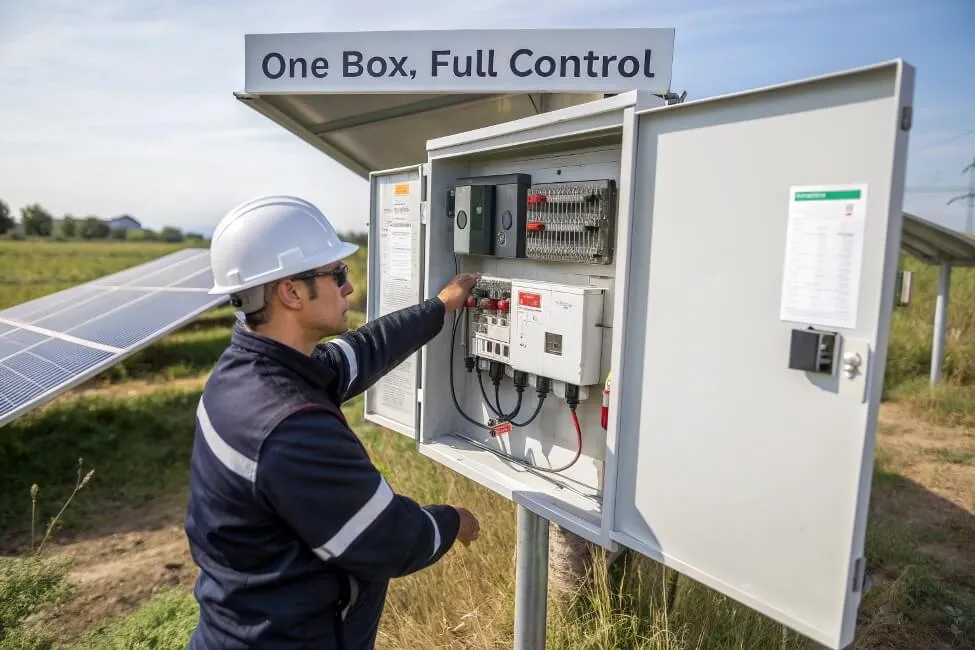
A combiner box is an enclosure that consolidates multiple PV string outputs into a smaller number of downstream circuits headed toward the inverter. In utility-scale solar, it is part of the conventional DC collection architecture and often includes protective and disconnect-related features depending on configuration. Wood Mackenzie treats the combiner box system as the conventional benchmark architecture in its 2026 outlook, and Eaton describes its utility-scale combiner boxes as designed to reduce wiring requirements and installation time while supporting longer strings and fewer connection points in 1500 V DC systems.
This is why combiner box systems remain common in engineering discussions: they are deeply familiar to the market, widely understood by EPC teams, and fit comfortably into established utility-scale solar workflows.
Trunk Bus vs Combiner Box: Core Differences
The best way to compare Trunk Bus vs Combiner Box is by looking at how each architecture changes field work, project structure, and operational trade-offs.
Installation approach
A trunk bus architecture is usually positioned as more prefabricated and plug-and-play. TE explicitly highlights pre-assembled components, faster installation, lower maintenance, and reduced installation cost, while Voltage Energy describes a combiner-free architecture with factory-assembled, site-specific design.
A combiner box architecture, by contrast, is more rooted in the conventional approach of collecting strings into field-installed enclosures and then routing aggregated output forward. That does not make it outdated. It makes it more familiar and often easier for teams to adopt without changing their design habits as dramatically.
Wiring complexity
This is one of the biggest reasons Trunk Bus vs Combiner Box has become such an important comparison. Trunk bus vendors consistently emphasize fewer field connections, less wiring complexity, and reduced installation effort. Voltage Energy states that its modular architecture consolidates up to eight inputs into a centralized pathway with pre-engineered, overmolded connection points.
A combiner box can still reduce wiring requirements compared with more fragmented field wiring, and Eaton explicitly markets that benefit. But trunk bus architectures are generally marketed around a more aggressive reduction in field termination and collection complexity.
Design flexibility
This is where the comparison gets more nuanced. Trunk bus is often strongest when the project layout is highly repeatable and benefits from standardization. TE emphasizes East-West and North-South trunk cable orientation options and the ability to adapt site layout, but that flexibility still sits within a more engineered system logic.
A combiner box may feel more comfortable to teams working within conventional DC architecture, especially when the project is designed around familiar string aggregation methods. In some organizations, that design familiarity is itself a form of flexibility because it reduces training friction and execution risk. This is an inference based on how conventional combiner systems are positioned relative to newer trunk bus approaches.
Reliability and connection points
Shoals’ EBOS overview argues that reducing in-field installation errors and connection points can lower risk in DC power distribution, and its article specifically links prefabricated, factory-tested EBOS solutions to lower failure risk. That supports the broader market argument for prefabricated trunk bus or harness-based architectures.
That said, combiner box systems are not inherently unreliable. Their strength is that they are well understood, can be built to recognized standards, and have long been part of utility-scale solar design practice. Eaton’s utility-scale combiner boxes are presented as listed, configurable, and suited for harsh environments.
When Trunk Bus Is the Better Fit
In many real-world cases, trunk bus is the better fit when the project shares several of these characteristics:
The site has labor constraints or expensive field labor. Voltage Energy explicitly says its trunk bus architecture is well suited to remote sites with labor constraints and projects requiring fast turnaround.
The project uses long tracker rows and repeatable utility-scale layouts. Voltage Energy highlights utility-scale plants and tracker-based arrays with long rows as ideal use cases.
The developer or EPC wants greater prefabrication and fewer field terminations. TE and Voltage Energy both emphasize pre-assembled, plug-and-play installation and reduced field complexity.
The project team wants a combiner-free architecture to streamline DC collection. Voltage Energy states that directly.
A useful way to think about it is this: trunk bus tends to be strongest when build speed, repeatability, and field simplification are central to project success.
When a Combiner Box Is the Better Fit
A combiner box is often the better fit when the project or organization values these advantages:
The team prefers a conventional and well-understood architecture. Wood Mackenzie explicitly frames the combiner box as the conventional benchmark architecture.
The project is being executed by teams already optimized around standard combiner-based workflows.
The owner or engineer wants a familiar enclosure-based aggregation point with established protection and configuration practices. Eaton highlights configurability, disconnect options, enclosure options, and utility-scale applicability.
The organization is not ready to redesign procurement, installation, and O&M assumptions around a newer trunk bus model.
In other words, a combiner box is often the safer choice organizationally even when it is not always the most aggressive choice architecturally.
Cost, Labor, and O&M Considerations
This is where many articles oversimplify Trunk Bus vs Combiner Box. The right architecture is rarely just about material cost. It is about the total project system.
Wood Mackenzie’s 2026 report specifically compares cost structures, installation requirements, operational trade-offs, and project economics across factory-installed trunk bus, field-installed IPC trunk bus, and conventional combiner box systems for a typical utility-scale project. That alone tells you the industry no longer sees this as a single-variable purchasing decision.
A sensible way to frame the trade-offs is:
Decision Area | Trunk Bus | Combiner Box |
Field labor | Often lower due to prefabrication and fewer field connections | Can still reduce wiring and installation time, but usually within a more conventional field-built workflow |
Design familiarity | May require a bigger shift in project design thinking | Usually higher because it follows conventional utility-scale architecture |
Wiring complexity | Typically reduced through centralized or modular collection paths | Reduced versus unmanaged field wiring, but still enclosure-centric |
Project fit | Strong for standardized, fast-build, labor-sensitive projects | Strong for teams prioritizing familiarity and conventional engineering workflows |
For O&M, the answer is not purely one-sided. Trunk bus suppliers often argue that fewer field terminations and more standardized architectures support easier long-term reliability. Shoals’ EBOS article supports the general premise that factory-tested components can reduce field error risk. But the actual O&M outcome still depends on product quality, documentation, field execution, and owner capability.
A Practical Selection Framework for Developers and EPCs
If you are deciding between Trunk Bus vs Combiner Box, use this simple framework.
Choose trunk bus when:
your rows are long and highly repeatable
labor is scarce, expensive, or difficult to scale
schedule compression matters
you want more prefabrication and fewer field terminations
your team is open to a more engineered, standardized DC collection model
Choose combiner box when:
your organization prefers conventional eBOS architecture
the EPC and engineering team are optimized around established workflows
you want enclosure-based string aggregation with familiar configuration options
the project benefits more from process familiarity than from architectural change
Ask these questions before you decide:
Where is our biggest cost risk: material, labor, or schedule?
How standardized is the array layout?
How much field termination do we want to eliminate?
How comfortable is our team with a less conventional architecture?
What O&M model will the owner actually use after COD?
That is usually a better decision path than asking which option is “better” in general.
Conclusion
So, which eBOS architecture is better for utility-scale solar: trunk bus or combiner box?
The most accurate answer is that trunk bus is often better when a project benefits from prefabrication, field-labor reduction, and streamlined DC collection, while combiner box systems remain better when conventional design familiarity, enclosure-based aggregation, and established workflows are the priority.
For U.S. utility-scale solar teams, this is increasingly a strategic architecture choice, not just a component choice. The winning decision usually comes from aligning eBOS architecture with project execution reality: layout, labor, risk tolerance, and lifecycle priorities.
FAQ
1. What is the difference between trunk bus and combiner box in solar?
A trunk bus uses a centralized conductor pathway with pre-engineered connection points to collect DC power, while a combiner box aggregates multiple string inputs inside an enclosure before routing power downstream.
2. Is trunk bus replacing combiner boxes in utility-scale solar?
Not universally. Wood Mackenzie treats trunk bus and conventional combiner box systems as primary competing architectures in the current market, which suggests both remain important.
3. When is trunk bus better than a combiner box?
Trunk bus is often better when projects have long, repeatable rows, labor constraints, tight schedules, and a strong preference for prefabricated installation with fewer field terminations.
4. Are combiner boxes still used in utility-scale solar?
Yes. Combiner box systems remain a conventional utility-scale eBOS architecture and are still marketed for cost reduction, installation efficiency, and configuration flexibility.
5. Which is more cost-effective: trunk bus or combiner box?
There is no universal winner. Project economics depend on labor, layout, installation method, and operational trade-offs. Wood Mackenzie’s 2026 outlook evaluates those trade-offs across architectures rather than declaring one option universally superior.
6. Is trunk bus better for tracker-based arrays?
It often can be. Voltage Energy specifically identifies utility-scale plants and tracker-based arrays with long rows as a strong use case for trunk bus architecture.


Comments